

Table of Contents
Festival Season, the Scent of the Old Rises Again
Under the scorching midsummer sun, dancers in long-sleeved hanbok fill the courtyard with slow, deliberate steps. The drumbeat echoes, and a tightrope walker balances high above the sky. Just a few years ago, this scene might have been dismissed as a museum-curated event—but in the summer of 2026, it’s pulsing back to life at festival grounds across Korea. Traditional cultural heritage is stepping out of the display case and into a living, breathing experience where people meet it face-to-face, not as spectators but as participants.
With the pandemic behind us and daily life back on track, outdoor festival culture has roared back, and in that revival, traditional content is catching the eyes of a new generation. It’s not just a retro wave; it’s tradition reinterpreted with a modern sensibility, drawing in both young locals and international visitors alike.
When Tradition Becomes an Experience
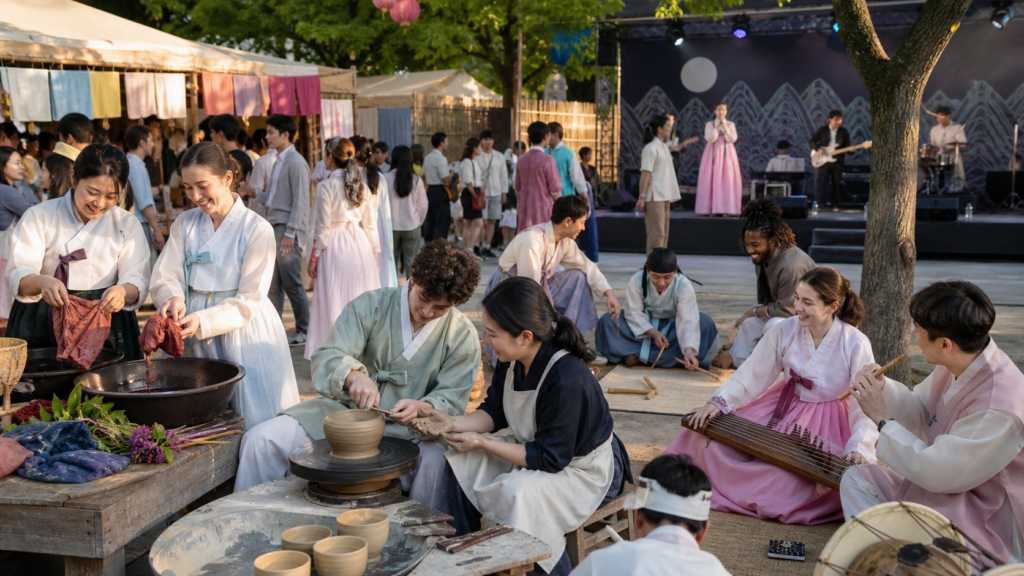
What’s changed is the way we approach tradition. Old-school festivals focused on showing you a performance; now, the trend is all about jumping in and doing it yourself. Instead of watching ssireum (Korean wrestling), you step up to challenge someone. Instead of hearing about traditional games, you learn them with your body. It’s a shift from folk-village-style spectating to hands-on cultural spaces.
Workshops like hanbok try-ons, traditional instrument playing, natural dyeing, and pottery making have become must-have programs at festivals. Participants make, wear, and play—directly connecting with tradition, then sharing it all on social media. That sharing brings in new visitors, creating a self-sustaining cycle.
Local Festivals Rise Again, Communities Recover
This revival of summer traditional festivals is also deeply meaningful for community recovery. Villages that had been losing steam due to population decline and urban concentration are rebuilding their traditional festivals, forging ties with outside visitors. Old markets, seasonal rites, and village rituals are being rediscovered as tourism assets, breathing new life into local economies.
Major traditional festivals like the Gangneung Danoje Festival, the Andong International Mask Dance Festival, and the Jeonju World Sound Festival are gaining international recognition through UNESCO Intangible Cultural Heritage listings and global promotion, drawing foreign visitors to the provinces. The Hallyu tourism that once centered on Seoul is now spreading out across the country.
Where Modern Meets Tradition: The Fusion Potential
One fascinating angle in this rediscovery of traditional festivals is the crossover with contemporary culture. A traditional pansori performance is followed by an indie band set; classical dance and modern dance share the same stage. A food corner reimagines old recipes with modern plating. Festival spaces are designed so that past and present don’t clash but converse.
This fusion lowers the entry barrier for younger generations and foreigners who aren’t steeped in tradition. You don’t have to be perfectly traditional or deeply knowledgeable from the start. The key is getting people in the door, and once they’re there, they naturally encounter the threads of tradition.
The Conditions for a Living Heritage
For traditional cultural heritage to breathe outside museum walls, it needs repeated experiences and intergenerational transmission. When summer festivals become annual events woven into community memory—not one-off spectacles—they become living heritage. Right now, across Korea this summer, people are working to build those conditions.
Tradition isn’t a taxidermied past; it’s a culture that breathes alongside us in this very season. That possibility is being tested once again at the 2026 summer festival grounds. In courtyards filled with drumbeats and laughter, the conditions for living heritage are being fulfilled, one by one.
Sources: KBS World, Cultural Heritage Administration, industry reports, 2026.