

Table of Contents
What You Should Check Before the Summer Schedule: Platform Strategy
Come summer, new variety shows flood in—but that old line doesn’t hold up if you’re just checking broadcast schedules anymore. Weekend shows on terrestrial and cable channels still air according to your daily rhythm, but global OTTs like Netflix drop entire seasons at once or build buzz at different speeds per country. Even the same program—some watch it at premiere time, others discover it days later via global rankings.
So more important than counting ‘how many shows are competing this summer’ is what kind of variety each platform puts forward as its flagship. For 2026, I see three big keywords for Korean variety: expansion of long-running formats, observation shows centered on star hosts, and survival shows that are sharper by genre.
From a fan’s perspective, more options can mean more fatigue. But if you look closely, not every show is fighting for the same viewing time. The person watching a dating reality show, the one waiting for a brain game, the one following a chef competition—their tastes are quite different. Right now, the variety market is moving away from chasing a single ‘national program’ and toward holding onto different fandoms for longer.
Netflix Pushes Its Familiar Hits Further
The first thing that stands out in Netflix’s 2026 Korean lineup is the season-based variety shows. ‘Solo Hell 5’ is the first Korean reality show to reach a fifth season. The basic structure—participants form relationships in ‘Hell Island’ and only move to a more comfortable environment when they become a couple—remains, but each season adjusts casting and relationship pacing. Still, does reaching season five mean the show is evolving, or just repeating itself?
Dating shows don’t just end with who chose whom anymore. Right after release, participants’ speech patterns, fashion, jobs, and relationship interpretations spread quickly through short clips and communities. For English-speaking fans, Korean dating culture, age titles, and the subtle group dynamics might seem unfamiliar—but that cultural difference is exactly what makes international viewers hit ‘next episode’.
‘Mystery Investigation Team 2’ and ‘The Devil’s Plan 3’ are also continuing. Both shows rely on relationships between participants, but they lead with deduction and strategy instead of romance. Especially in brain survival games, the fun comes less from solving a single problem and more from watching alliances form and crumble. The bigger question isn’t who’s smartest, but who can persuade others until the end.
Yoo Jae-suk and Na Young-seok: A Change That Can’t Be Explained by Star Names Alone
Netflix’s 2026 variety slate includes ‘Yoo Jae-suk Camp’, where Yoo Jae-suk runs a lodging business. It’s known to feature Lee Kwang-soo, Byun Woo-seok, and Ji Ye-eun. On the surface, it’s familiar to have a famous host lead the show, but interestingly, recent lodging-type variety has shifted to showing both guests’ stories and the cast’s labor.
Na Young-seok PD and Lee Seo-jin’s ‘Seojin’s Dallas’, and ‘Why Are You Climbing?’ where cast members with little hiking experience tackle winter mountains, follow the same trend. Instead of just showing scenic travel destinations, they turn the humor from how people actually clash and adapt in unfamiliar spaces. A flashy mission doesn’t stick as long as a clip of the cast’s reactions.
tvN is also continuing its tradition of travel, cooking, and survival variety. In the first half of 2026 lineup includes the return of a beloved travel format like ‘Youth Over Flowers: Limited Edition’, and ‘Undercover Chef’ where chefs work low-ranking jobs in unfamiliar kitchens to complete missions. Familiar production names might seem like safe bets, but it also means viewers want new combinations and fresh situations. But can a familiar production team still surprise us?
Cooking and Survival Are Now on Different Rhythms
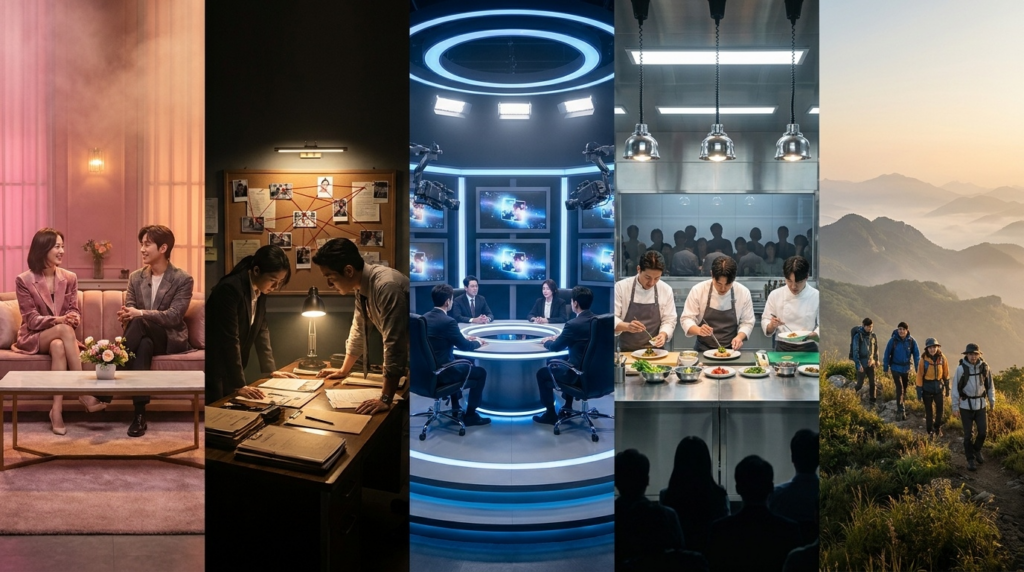
A few years ago, cooking shows were all about recipes and restaurant recommendations. But now, cooking itself has become the language of competition. Netflix has previewed team-based cooking battles in ‘Culinary Class Wars 3′, and tvN also scheduled a program that emphasizes chefs’ on-site adaptation and survival. Same ‘food’ subject, but one side goes for a large-scale competition, the other for an observation show in an unfamiliar kitchen.
This difference matters for international viewers too. Even if they’re interested in Korean food, not everyone wants to learn complex Korean recipes. Some watch for the chef’s technique, others for the tension and reconciliation among team members. Food is a globally relatable subject, but what keeps viewers watching to the end is ultimately the drama between people.
Survival shows are the same. Strong elimination rules alone don’t create buzz. Viewers need to follow the participants’ strategies, and the results must be convincing. Especially for globally released shows, they need rules that are understandable even with subtitles, emotional arcs that resonate across cultures, and editing that makes you click next. That’s why variety fans are particularly meticulous about whether the rules were fair.

Long-Lasting Fandoms Matter More Than a Single Mega Hit
If you see the rise of Korean variety as just a battle between broadcasters and OTTs, you’re missing something. Now, even after a show ends, participants’ next activities, short clips, fan translations, and overseas reaction videos keep going. It’s clearly different from the past when buzz died the moment the broadcast ended.
The case of ‘Running Man’—after airing for years in Korea, discussions for a US version emerged—shows where a format’s longevity comes from. The simple setup of chase games is important, but it was the accumulated cast relationships and missions that could be varied repeatedly that drew interest from overseas producers. Format export isn’t just moving a title; it’s recreating why people kept wanting to watch that show in a different culture. And what about the shows that haven’t even been announced yet?
When watching variety this year, don’t just look at first-week rankings. It’s more fun to see if a new season gets made, how naturally participants flow into the next content, and which scenes international fans share in their own language. The real fun for a 2026 variety fan will be watching which show shakes up the timeline next—a dating reality, a brain game, or an unexpected cooking survival.
Sources: Netflix, ‘What’s Next on Netflix Korea: Every Emotion, One Bold Story’, 2026-01-21; Netflix, ‘Can’t Get Enough of K-Variety? New Unscripted Series Are Coming Soon’, 2024-07-26; OSEN, tvN 2026년 5~6월 편성 보도, 2026-04-30; Deadline, ‘Korean Format Running Man Heads To U.S. With Hellcat’, 2026-06.